
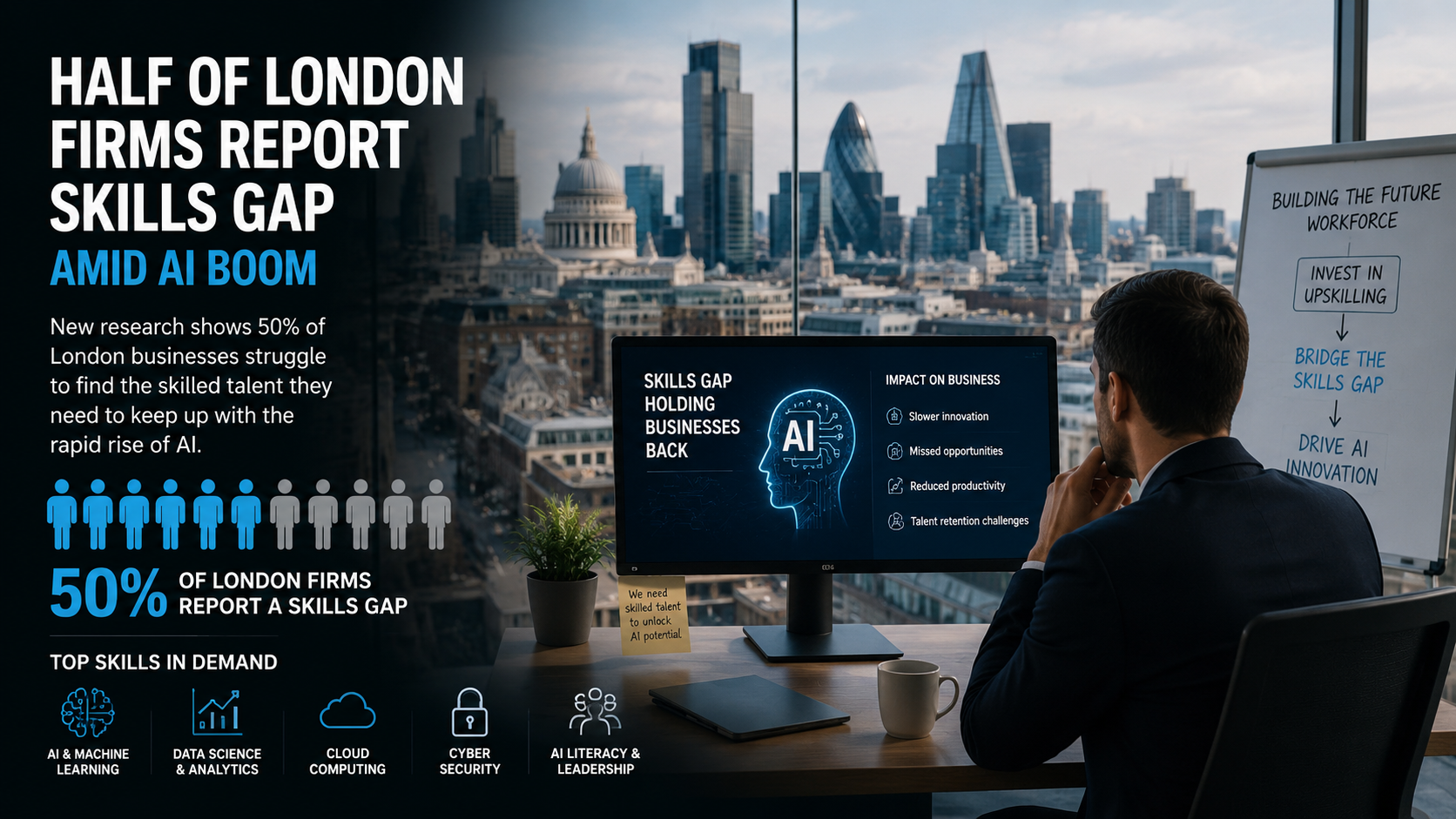

























Half of London businesses say their workforce lacks some of the skills needed to meet organisational requirements in the age of artificial intelligence, according to a survey of more than 2,000 business leaders conducted by Survation on behalf of BusinessLDN.
The research found that only 50% of firms believe their current workforce possesses the skills and capabilities required for future success, down from 63% a year earlier.
The proportion of businesses reporting significant skills and capacity shortages rose to 15%, up sharply from 4% in 2025 and marking the highest level recorded since the annual survey began.
The findings come as AI adoption continues to accelerate across the capital, with three-quarters of businesses saying they already use artificial intelligence in some form, while only 5% have no plans to adopt the technology.
Among organisations already using AI, 85% said the technology had changed the skills needed within their workforce, increasing demand for capabilities such as critical thinking, ethical reasoning and decision-making.
The survey of 2,043 business leaders from a range of sectors also found that 35% of firms reported some level of skills and capacity shortages within their organisations.
A further 12% of businesses plan to adopt AI technologies in the future, while 8% are currently exploring potential use cases and implementation strategies.
Among companies experiencing skills shortages, 60% reported a lack of advanced digital skills, while 23% said they faced shortages in basic digital capabilities.
Demand for advanced digital skills is expected to continue rising, with 78% of businesses anticipating a significant need for such skills over the next two to five years, compared with 66% last year and 56% in 2023.
When asked about workforce development, 13% of firms said training investment would remain unchanged, while 5% expected spending on employee training to decrease.
The survey also found that 17% of businesses currently have no job vacancies, while 20% plan to reduce headcount and 76% do not expect to cut staff numbers.
Among organisations planning workforce reductions, 25% cited cost-cutting measures as the primary reason, 24% pointed to reduced demand for entry-level roles due to AI adoption, 23% reported lower demand for mid-career positions and 14% highlighted broader economic pressures or changes to their business models.
Mark Hilton, policy delivery director for people and skills at BusinessLDN, said: “While London businesses are embracing AI, many are finding it challenging to stay on top of their workforce skills needs given the pace of change.
“Positively, employers are responding by increasing investment in training, but to properly close skills gaps it is essential we have a more agile skills system that is responsive to these rapidly changing needs.”