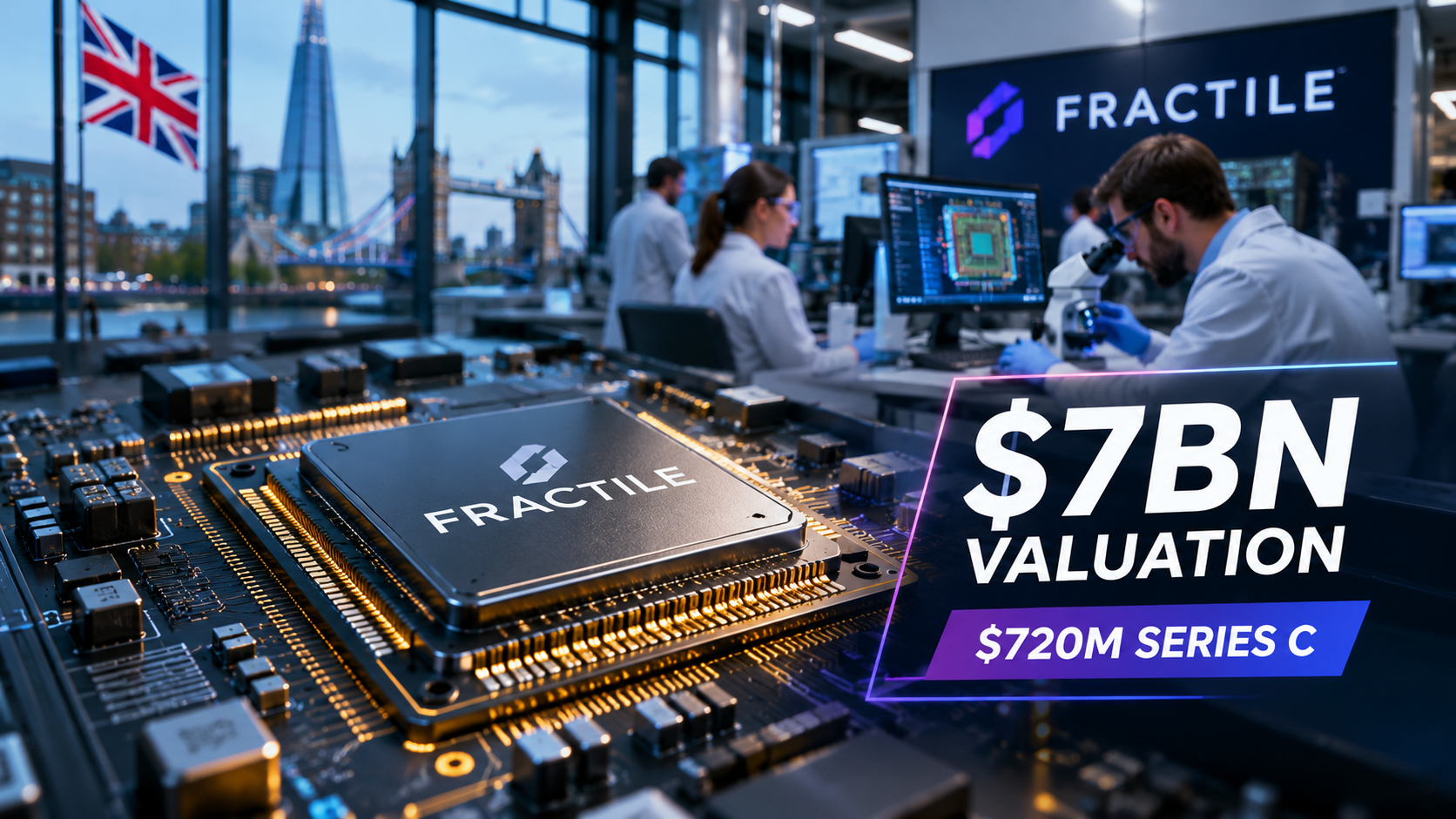






















UK semiconductor start-up Fractile has secured a $7bn valuation after attracting investment from some of Silicon Valley’s leading venture capital firms. The four-year-old company’s approach to chip design, which it describes as a “new recipe”, has helped it become one of the UK’s most valuable start-ups.
Headquartered in London, Fractile is developing its own artificial intelligence chips featuring custom-built memory. Founder Walter Goodwin says the technology could deliver faster and more efficient responses to chatbot queries, a process known as inference.
Founded in 2022, Fractile has raised $720m in a funding round backed by Thrive Capital, Founders Fund, Conviction, Alphabet’s independent venture arm CapitalG, Lightspeed Venture Partners and other investors. According to people familiar with the deal, the investment values the company at $7bn, including the latest funding. This represents a significant increase from its valuation of approximately $1.1bn in a funding round in May.
Anthropic has reportedly expressed interest in becoming one of the first customers for Fractile’s chips, according to people familiar with the discussions.
Fractile is among several start-ups developing specialised semiconductors for artificial intelligence applications. These companies are targeting growing demand for chips capable of processing AI workloads more quickly and cost-effectively than Nvidia’s market-leading graphics processing units (GPUs).
Goodwin said the semiconductor industry had historically prioritised increasing processing power rather than improving memory performance.
“Over the past 25 years, we’ve got a million times faster: we’ve crammed a million times more Flops [a measure of computing power] on to our leading chips,” said Goodwin. “But we’ve got about 40 times more bandwidth to memory in that same period of time. So you’ve had a 25,000-fold outstripping of maths capability to memory.”
He added that the result was that today’s most advanced AI models were “drinking through a straw”, with their substantial computing capabilities restricted by the speed at which data could be retrieved from memory.
Fractile is developing customised memory technology that will be integrated directly into its chips to retain context for AI queries. Goodwin claims the approach could improve response speeds by up to 10 times.
Competition in the AI inference chip market is intensifying. Nvidia acquired chip start-up Groq last year and introduced its own inference chip in March. Other companies developing alternative designs include Etched, MatX and UK-based Olix.
However, the sector faces considerable uncertainty over the future direction and pace of AI development. Growth forecasts have been moderated in recent months amid increasing costs and public concerns about the technology.
Fractile has yet to release a commercial production chip, meaning its $7bn valuation is largely based on the potential of its prototypes and technological developments. The company plans to launch its first product next year.
In May, Fractile raised approximately $220m at a valuation of around $1bn in a funding round led by Accel, Founders Fund and Factorial Funds.
Philip Clark, an investor at Thrive Capital, which co-led the latest funding round, said the inference market Fractile is targeting would soon be “at least as large as the market Nvidia is addressing today”.
He added that the company’s focus on improving efficiency and processing speeds could make its chips particularly suitable for AI agents that “work for many hours or eventually many days on their own”.
Most competitors, including Nvidia, rely on a type of dynamic random-access memory (DRAM) known as high-bandwidth memory (HBM) to manage the large volumes of data required by AI models.
However, HBM is expensive and increasingly difficult to source, as memory manufacturers such as SK Hynix and Micron face challenges keeping pace with growing demand from the AI industry.
Instead, Fractile has been developing what Goodwin described as a “secret project to make custom DRAM, which we stack on top of our chips”.
The company’s design differs from competing technologies by combining memory and computing power within a single chip, rather than relying on separate pieces of silicon operating in parallel.
The UK’s sovereign AI fund also participated in the latest funding round. Goodwin said the fund was a “driving force” for some members of the team who wanted to advance frontier AI technology from London. However, he added that Fractile “was very proud and excited to be a global company”, with offices in the US and Taiwan.
Sarah Guo, who leads venture capital firm Conviction, said: “The industry is rapidly converging on a view Fractile’s team was early to develop: that memory bandwidth and capacity are becoming the central constraints on AI inference, and need to be designed together,” said Sarah Guo, who runs venture capital firm Conviction. “We backed them because they have the rare expertise to deliver on it.”